

2026-05-11
How much can choosing the right LED street lights save you? In urban road renovation projects,Choosing the right LED street light is about more than watts. This guide explains the market context, Europe’s EN 13201 standards, how to pick the correct light-distribution type (Type II/III/IV), and why Unicorn Lighting’s Meta and Poseidon G3 series are smart, standards-ready options—plus two more must-check factors for a successful, long-lived roadway lighting project.these lights significantly reduce your costs and boost economic efficiency.
Global street lighting is evolving fast under smart-city agendas, carbon-reduction targets, and rising energy costs. As of 2024, the market is ~USD 12 billion and forecast to grow 8–10% CAGR over the next decade, driven by LED retrofits, IoT-enabled controls, and growing demand for solar/ hybrid solutions. Municipalities favor LEDs for lower power draw, long lifetime, reduced maintenance, and easy integration with connected platforms for remote monitoring and adaptive dimming. At the same time, buyers must navigate high upfront costs, supply-chain swings, and concerns over light pollution—making standards compliance and optical precision more important than ever.
What this means for you: prioritize luminaires that combine high efficacy with precise optics, robust surge protection, and proven controls. This sets you up for superior energy performance and a quick, defensible payback.
EN 13201 defines several series of classes, each tied to concrete, maintained photometric criteria (i.e., design values reduced by a maintenance factor):
M-classes (M1–M6) — for motorized traffic routes (medium to high speeds). You design to luminance on the carriageway with limits on uniformity, disability glare, and lighting of surroundings. Typical minima include:
Lavg: 2.0 / 1.5 / 1.0 / 0.75 / 0.50 / 0.30 cd·m⁻² (M1→M6)
Uo (overall uniformity): ≥ 0.40 (M1–M4); ≥ 0.35 (M5–M6)
Ul (longitudinal uniformity): ≥ 0.70 (M1–M2), 0.60 (M3–M4), 0.40 (M5–M6)
fTI (max disability glare): ≤ 10% (M1–M2), 15% (M3–M5), 20% (M6)
REI (edge illuminance ratio, min): 0.35 (M1–M2), 0.30 (M3–M6)
Wet-condition uniformity Uow = 0.15 may be required by national practice.
C-classes (C0–C5) — for conflict areas (roundabouts, complex junctions, shopping streets). You design to horizontal illuminance with Uo ≥ 0.40; Ē (min maintained) steps: 50 / 30 / 20 / 15 / 10 / 7.5 lx.
P-classes (P1–P7) — for pedestrians & pedal cyclists (footways, cycleways, residential roads, parking, schoolyards). You design to horizontal illuminance with minimums for Ē and Emin; where facial recognition is required, add Ev,min and Esc,min at 1.5 m height. Examples:
P1: Ē 15 lx, Emin 3 lx, Ev,min 5 lx, Esc,min 5 lx
P4: Ē 5 lx, Emin 1 lx, Ev,min 1.5 lx, Esc,min 1 lx
(For uniformity, the actual maintained Ē should not exceed 1.5× the class minimum.)
HS-classes (HS1–HS4) — for pedestrian/cyclist areas using hemispherical illuminance: Ēhs ≥ 5 / 2.5 / 1.0 lx with Uo ≥ 0.15 (HS4 not determined).
Additional classes for visibility & safety perception:
SC-classes (SC1–SC9) — semi-cylindrical illuminance Esc,min at 1.5 m (10 → 0.5 lx) for facial recognition and perceived safety.
EV-classes (EV1–EV6) — vertical illuminance Ev,min (50 → 0.5 lx) where vertical surfaces must be seen (e.g., toll/interchange areas).
Specifications should address daytime appearance (columns, brackets, height/scale), night-time appearance/comfort (CCT, CRI, mounting height, lit appearance, optical guidance, timed reductions), and minimizing upward/intrusive light (optics/tilt, mounting height, dimming profiles).
Pedestrian crossings may require local lighting aimed to provide positive contrast and driver attention, with vertical levels exceeding the carriageway’s horizontal values.
For C and P installations, Annex C gives maximum fTI values to limit disability glare (e.g., C0–C2 ≤ 15%, P1 ≤ 20%, P6 ≤ 35%).
In IES/industry practice, “Type” describes the lateral spread and forward throw of a luminaire. Selecting the right type improves uniformity, reduces glare, and keeps light on the pavement—not in drivers’ eyes or neighbors’ windows.
Type II — For narrow to medium widths (residential streets, jogging paths, wider sidewalks, entrance roadways). A rule of thumb: area width ≤ 1.75× mounting height(usually at 6 or 7 meters). Great for side-of-road mounting with modest forward throw.
Type III — For roadways and general parking where you need a broader coverage and stronger forward throw to the curb lane and beyond. Ideal for collector roads and many car parks.
Type IV — For perimeter/edge lighting with strong forward throw, often used along site perimeters and wide walkways parallel to building lines or lot edges to push light deep into the target area.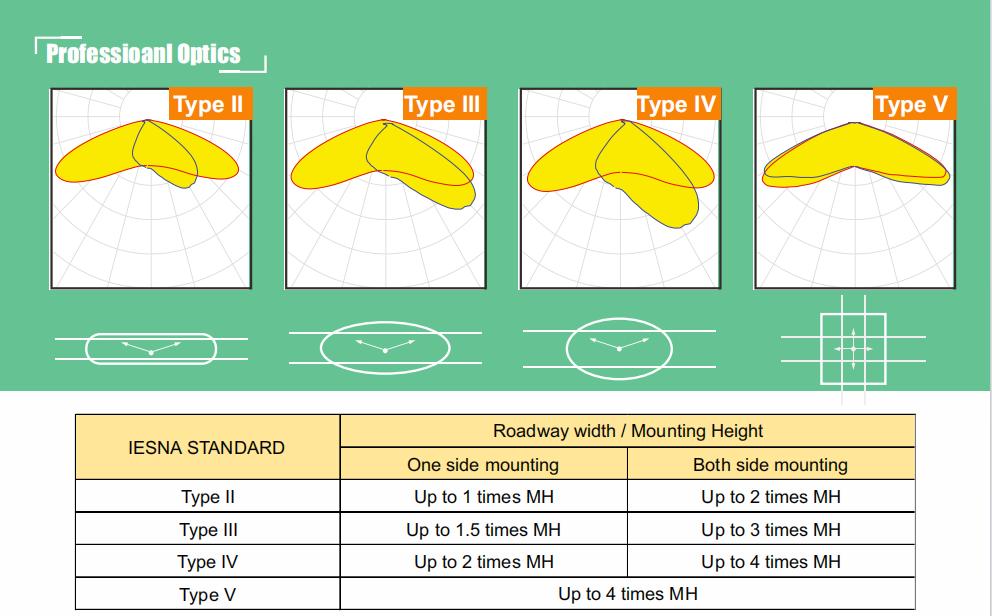
Pro tip: choose optics that meet your EN 13201 class with minimal spill. When in doubt, simulate spacing and setback to confirm U0, Ul, TI, and SR compliance—not just average luminance/illuminance.
When you need EN-ready performance with flexible optics and controls, Unicorn Lighting offers two complementary street-light platforms:
Efficacy: 150–160 lm/W, enabling lower PDI at the same class.
Wattages: 24–200 W with Type II/III/IV/V optical options.
Durability: IP66 (luminaire), IK08 impact; ULR 0–0.35% to limit sky glow.
Electrical: PF > 0.95, THD < 8%, 100–277 V; L70B10 > 102,000 h (TM-21/LM-80 based).
Controls: 0/1–10 V, PWM, Triac, AstroDIM; optional photocell; surge 6 kV/10 kV (20 kV SPD optional).
CCT: 3000–6500 K; CRI > 70.
When to choose Meta: residential streets, municipal retrofits, and mixed-use areas where Type II or Type III optics at 24–150 W often nail M- or P-class targets with excellent value and straightforward controls. Pair Type IV where forward throw along edges is desirable.
Efficacy: up to 180 lm/W for standout energy performance.
Wattages: 24–240 W; optical set T2M/T2S/T3M/T3S/T4S for fine-tuned roadway geometry.
Durability: IP66, IK08; L70B10 > 108,000 h.
Controls: default AstroDIM; optional 0/1–10 V, PWM, Triac; NEMA and Zhaga receptacles; DALI/D4i available for smart-node ecosystems.
Electrical: PF > 0.95, THD < 8%; 6 kV/10 kV surge (10/20 kV optional).
When to choose Poseidon G3: long-span roads or wider carriageways needing higher mounting heights or larger pole spacings; sites planning connected controls via NEMA/Zhaga/D4i. Use T3M/T3S on collectors/arterials and T4S for strong forward-throw perimeters.
Quick application map (examples):
Local/residential streets: Meta or Poseidon G3 @ Type II (or T2S/T2M) to balance spill and uniformity.
Collector roads & parking aisles: Meta Type III or Poseidon G3 T3M/T3S for broader lateral spread.
Perimeter roads & site edges: Meta Type IV or Poseidon G3 T4S for pronounced forward throw.
Standards alignment: Both families support the photometric precision and controls needed to meet EN 13201 classes while minimizing PDI/AECI through high efficacy and dimming/ scheduling.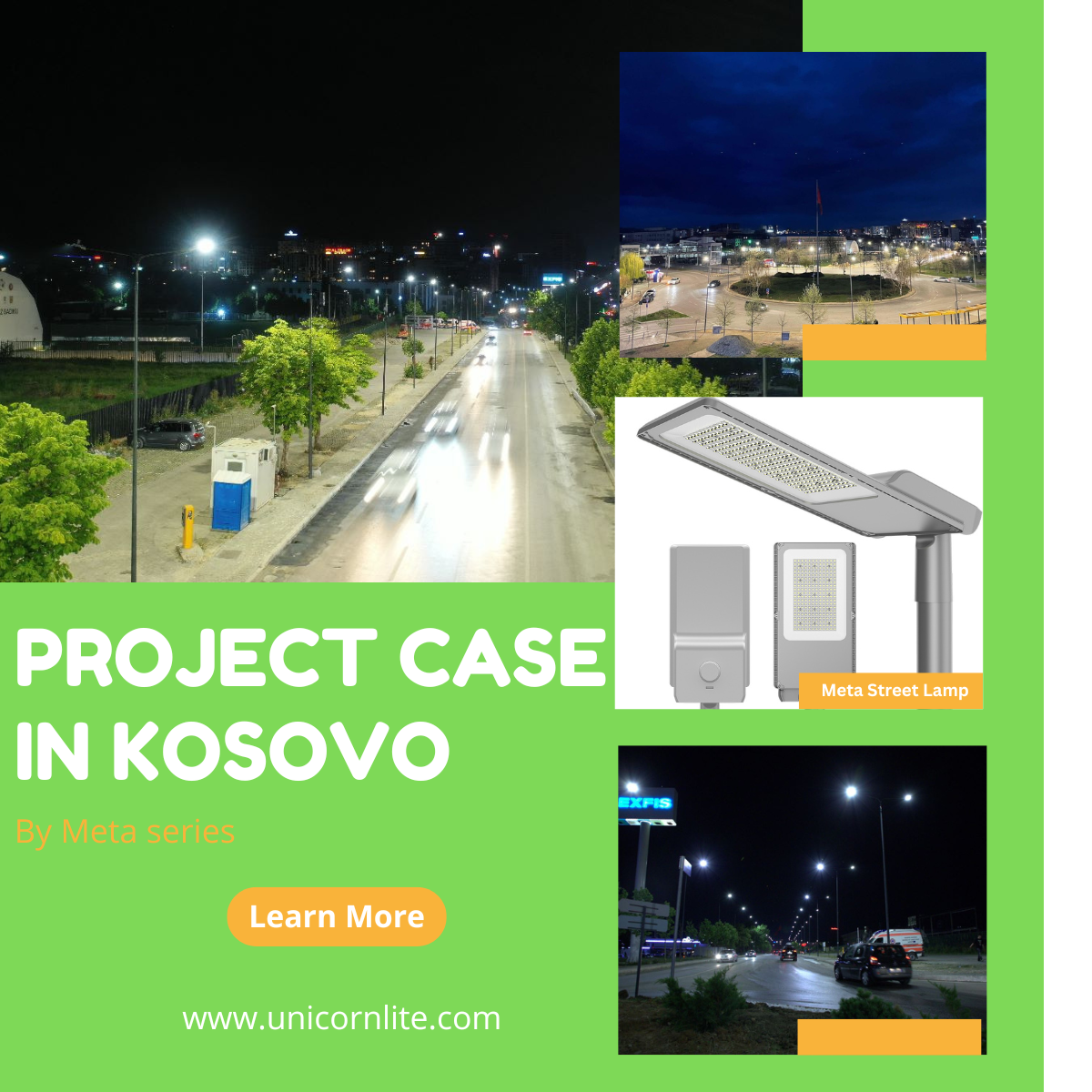
Beyond optics and efficacy, these four details determine real-world success:
AstroDIM for predictable dusk-to-dawn profiles; 0/1–10 V/PWM/Triac for building-automation tie-ins; DALI/D4i for fully addressable smart nodes (Poseidon G3). Then report PDI/AECI for apples-to-apples energy comparisons under EN 13201-5.
Look for L70B10 ≥ 100,000 h class lifetimes to reduce night work orders. Meta and Poseidon G3 meet or exceed this threshold in testing (TM-21/LM-80 based), lowering OPEX while maintaining class performance throughout life.
IP66 ingress and IK08 impact ratings are table stakes for road environments. Add 6–10 kV surge protection (consider 20 kV where grids are noisy or lightning-prone). Low ULR (upward light ratio) cuts sky glow and helps meet local dark-sky goals.
Choose 3000–4000 K where residential comfort and wildlife are priorities; 4000–5000 K for high-speed or task-critical roads (always balancing glare). Confirm TI is within your class limits and that SR supports peripheral detection for pedestrians and cyclists per EN 13201-2.
Define the EN 13201 class (M, P, or C) for each road segment based on use, speed, and traffic mix; note Lavg/Em, U0, Ul, TI, and SR targets.
Lay out optics by geometry: start with Type II/III/IV (or Poseidon G3 T2/T3/T4 variants), simulate pole height, setback, and spacing to hit uniformity and glare limits.
Optimize energy: pick the lowest-wattage SKU that still meets class metrics; model dimming profiles; publish PDI/AECI.
Harden the spec: require IP66, IK08, ≥ 6 kV SPD (consider 10–20 kV), PF > 0.95, THD < 8%, L70 ≥ 100k h.
Choose the platform:
Meta for mainstream municipal roads and value-driven retrofits at 150–160 lm/W with Type II/III/IV options.
Poseidon G3 for long-span or connected-controls projects up to 180 lm/W, with NEMA/Zhaga/D4i.
Standards-ready: optics and controls aligned to EN 13201-2 performance and EN 13201-5 energy reporting.
High efficacy: 150–160 lm/W (Meta) and up to 180 lm/W (Poseidon G3) to minimize PDI/AECI and accelerate ROI.
Rugged & long-life: IP66, IK08, L70B10 > 100k h, with 6–10 kV (up to 20 kV) surge options.
Flexible optics: Type II/III/IV (Meta), T2/T3/T4 (Poseidon G3) so you can precisely match geometry.
Q1: How do I justify one option over another?
Document class compliance (EN 13201-2) and compare PDI/AECI (EN 13201-5) at the same light levels and dimming profile. This makes value engineering transparent.
Q2: Which distribution should I start with for a residential street?
Begin with Type II (or Poseidon T2S/T2M) for the typical width-to-height ratio; verify spacing to maintain uniformity and limit glare (TI).
Q3: Do I need smart nodes on day one?
Not always. Consider AstroDIM first for baseline savings; specify NEMA/Zhaga on Poseidon G3 to add nodes later without changing the luminaire.
Whether you’re upgrading a neighborhood grid or planning a new arterial, start with lighting class, pick the right distribution, and choose a platform that balances efficacy, durability, and controls. Unicorn Lighting’s Meta and Poseidon G3 give you that blend—engineered for compliance, optimized for energy, and built for the road.
If you’d like, I can turn your target road list into a quick optics & spacing recommendation set (Type II/III/IV) with estimated PDI/AECI to support your proposal.


