2026-05-11
Modern padel court lighting has evolved from basic illumination to a critical technological system impacting player performance, operational cost, and spectator experience. The definitive shift to LED technology, now powering over 95% of new professional installations, is driven by its superior energy efficiency, longevity, and control. Beyond simple brightness, innovations in smart control systems, human-centric spectral tuning, and minimalist architectural integration are defining the next generation of courts. This article explores the technical parameters, advanced solutions, club owners, and architects must consider to create a court that is visually flawless, economically sustainable, and primed for the digital age.and thus choose the lighting solution that best suits your needs.
Professional-grade lighting is governed by precise photometric standards. Compliance is not optional; it is essential for safety, fair play, and broadcast quality.
Illuminance & Uniformity: The cornerstone metrics. Illuminance (measured in Lux) must be sufficient across the entire court. For recreational play, 200-300 Lux is adequate. Competitive amateur tournaments require 300-500 Lux. Professional play and high-definition television (HDTV) broadcast demand a minimum of 750 Lux, with major events exceeding 2000 Lux. More critical than peak brightness is uniformity—the ratio between the brightest and darkest zones. A uniformity ratio (U1 = Emin / Emax) target of ≤ 0.7 (or uniformity gradient U2 ≤ 0.5) is essential to eliminate shadows and visual adaptation strain for players.
Glare Control & Optical Precision: Direct glare from fixtures is a major hindrance, especially when tracking high balls. The Unified Glare Rating (UGR) should be kept below 25. This is achieved through precision asymmetric optics, deep louvres, and strategic fixture positioning to direct light onto the court, not into players' eyes.
Color Quality & Flicker: High Color Rendering Index (CRI > 90) is mandatory for accurate perception of the ball's color, court lines, and player details, crucial for both players and cameras. Equally important is the complete elimination of flicker, which can cause eye strain and disrupt slow-motion broadcast replays. Premium LED systems operate on flicker-free drivers.
Table 1: Lighting Requirements by Court Usage Level
|
Usage Level |
Average Maintained Illuminance (Lux) |
Uniformity (U1) |
Typical CRI |
Glare Control (UGR) |
|
Recreational / Training |
200 - 300 |
≥ 0.5 |
> 80 |
< 28 |
|
Club Competition / Amateur Tournaments |
300 - 500 |
≥ 0.6 |
> 85 |
< 25 |
|
Professional Training & Competition |
750 - 1000 |
≥ 0.7 |
> 90 |
< 22 |
|
HDTV Broadcast Events |
1400 - 2000+ |
≥ 0.7 |
> 90 |
< 19 |
Selecting the right hardware and layout is a science of balancing performance, aesthetics, and budget.
LED: The Undisputed Standard: LED technology has rendered metal halide and other legacy systems obsolete. Benefits are decisive: >60% energy savings, instant on/off capability, 50,000+ hour lifespan (dramatically reducing maintenance), and seamless integration with digital controls. The return on investment (ROI) for an LED retrofit is typically achieved within 2-4 years through energy and maintenance savings alone.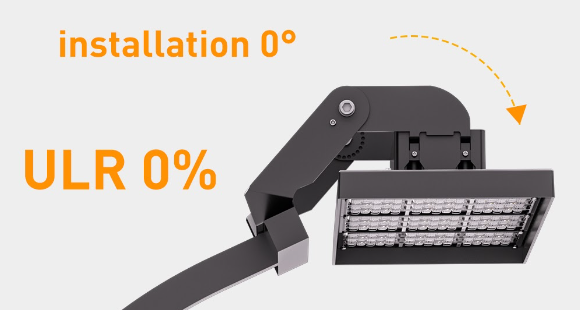
Indoor vs. Outdoor System Design:
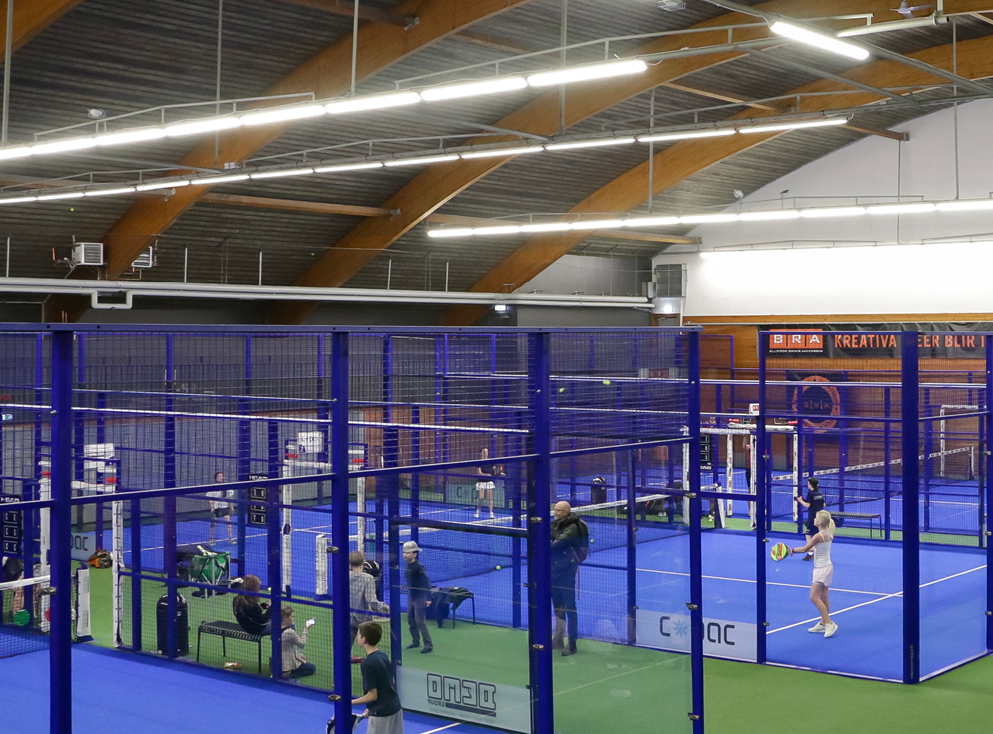
Indoor Courts: Typically utilize high-bay linear LED fixtures suspended from the ceiling. Key considerations include high IP65-rated protection against humidity and dust, and optical designs that ensure wide, even light distribution without dark corners.
Outdoor Courts: Demand robust IP66/IP67-rated LED floodlights. Installation strategies are critical:
Perimeter Pole Lighting: The most common solution. Advanced "off-court" designs use fewer, higher masts with precisely angled fixtures to illuminate multiple courts from the periphery, eliminating obstructive poles between courts and preserving valuable ground space.
Integrated Canopy Lighting: For courts with tension structures or fixed roofs, fixtures can be mounted directly to the canopy frame. This offers a clean, architectural look and excellent glare control but requires careful thermal and waterproofing design.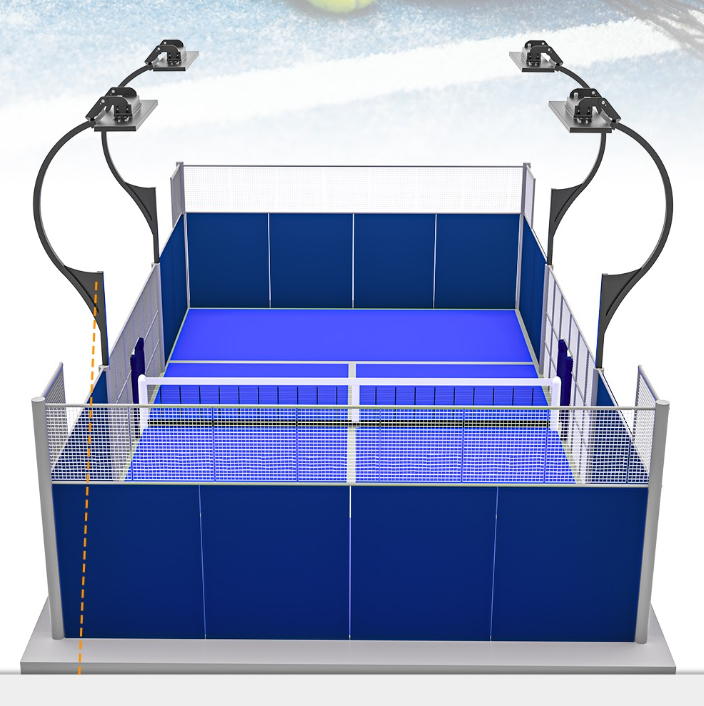
In lighting solutions, unicornlite brings decades of hands-on experience, having developed specialized products for both indoor and outdoor padel court lighting. This includes the Disruptive Series for indoor padel court illumination and the Revive Series for outdoor padel court lighting.
Outdoor Padel Court LightRevive,Premium light born for padel courts,Our Revive with innovative 100x60° is specifically designed for outdoor and indoor padel courts. The specialized optic makes better,uniform and alows lamp installed horizontally at 0° without any complex installation process, ULR 0%, low UGR, and no back light.Only 4pcs Revive padel light to cover one padel court, which is more energy-efficient and installation cost saving (4pcs 150W to meet 300lux illuminace and 0.6 uniformity / 4pcs 250W to meet 500lux illuminace and 0.7 uniformity).
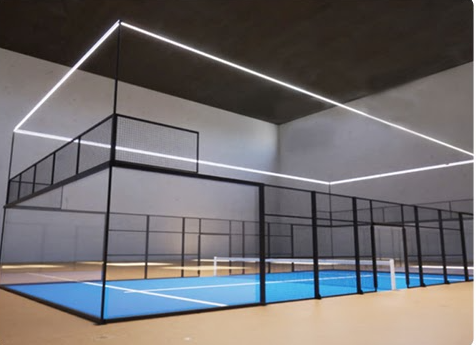
Indoor Padel court lightsDisruptive Padel Courts Lighting With specially designed linear asymmetrical optics P18, our linear padel court lights have advanced advantages compared to traditional floodlights, no shadow, no glare light, no back light . Light softer,and much improved uniformity. One optic P18 apply to all padel courts, no extra stock costs. Polarized light output from reflecting structure offers best uniformity and lux. It is easy installation and maintenance, no need poles and installation machine.