Choosing the right lighting for an industrial or commercial space is a critical decision that impacts safety, productivity, and operational costs. Among the most common choices are high bay and low bay fixtures. While they may look similar at a glance, their applications are distinctly different. Understanding these differences is key to selecting the optimal lighting solution for your facility.
Choosing the right lighting for an industrial or commercial space is a critical decision that impacts safety, productivity, and operational costs. Among the most common choices are high bay and low bay fixtures. While they may look similar at a glance, their applications are distinctly different. Understanding these differences is key to selecting the optimal lighting solution for your facility.
The Core Difference: Mounting HeightThe primary, defining factor that separates these two categories is their intended installation height.
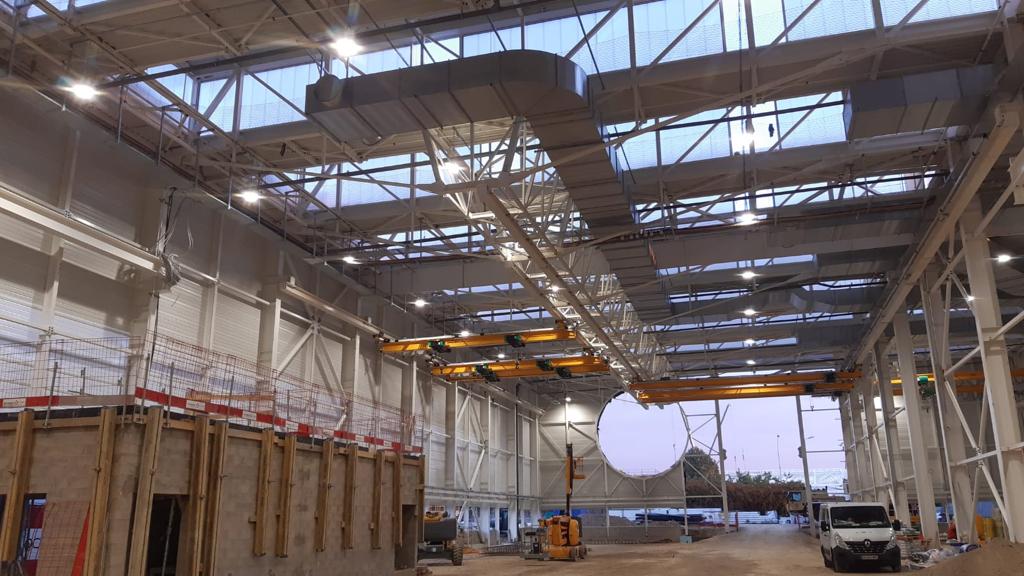
High Bay Lights are engineered for tall ceilings, typically starting at 20 feet (6 meters) and above. You'll find them in spaces like warehouses, distribution centers, aircraft hangars, large manufacturing plants, and gymnasiums. Their design focuses on projecting light downward over a significant distance, combating light loss and ensuring bright, uniform illumination at floor level.
 Low Bay Lights
 are designed for lower ceilings, generally ranging from about 12 feet to 20 feet (3.5 to 6 meters). They are suited for workshops, auto repair bays, smaller storage areas, retail spaces, and offices with higher ceilings. Since the mounting height is reduced, these fixtures provide wide, even light dispersion without creating excessive glare for people below.
Design and Performance CharacteristicsThe difference in mounting height drives several key design variations:
1. Light Distribution and Optics
High bay fixtures often use more focused optics or reflector bowls to channel light intensely downward. They need to "throw" light farther, requiring higher lumen packages (often 20,000+ lumens) to maintain adequate foot-candles on the work plane. Low bay fixtures usually feature a wider, more diffuse beam pattern (often a batwing distribution) to spread light evenly across a broader horizontal area at a closer range, minimizing harsh shadows and glare.
2. Brightness and Intensity
Due to the greater distance, a single high bay fixture is typically much brighter (higher lumen output) than a standard low bay. Using a low bay fixture in a high bay application would result in dark, poorly lit spaces between fixtures. Conversely, using a high bay in a low-ceiling area would create an uncomfortably intense, glaring hotspot.
3. Physical Form Factor
While not a strict rule, high bay fixtures often have a deeper or more pronounced housing to accommodate the necessary drivers and heat sinks for high-power LEDs and their optical components. Low bay lights can be more compact and low-profile, sometimes resembling rugged troffers or panel lights.
Modern Technology: LED RevolutionThe shift to LED technology has blurred some lines but reinforced the core application principles. Modern LED high bays and low bays offer superior energy efficiency, longevity, and light quality compared to old metal halide or fluorescent equivalents.
LED High Bays lights: Often come in modular designs (linear, UFO-style, panel-style) with options for different beam angles. They may incorporate features like prismatic lenses or reflectors for precise light control.
LED Low Bays lights: Frequently feature an integrated, flat lens that provides smooth, glare-free illumination. They prioritize visual comfort in spaces where people work directly under the fixtures for extended periods.
Choosing the Right Fixture: A Simple ChecklistMeasure Your Ceiling Height. This is your starting point. Above 20 feet, think high bay. Between 12-20 feet, lean toward low bay lights.
Assess the Space and Tasks.
What activities occur below? Do you need intense, focused light for detailed assembly (often high bay) or consistent, shadow-reduced light for general work (often low bay)?
Consider Layout and Spacing. High bays can be spaced farther apart due to their throw. Low bays need to be placed closer together for even coverage. Your fixture spacing plan will influence the choice.
Prioritize Quality Optics. Regardless of type, choose fixtures with professional-grade optics designed for their purpose. This ensures efficiency and visual comfort.
Think Long-Term. Factor in dimmability, smart controls, and durability (IP rating for dusty or damp environments). LEDs with a high CRI (Color Rendering Index) improve visibility and safety.
ConclusionIn summary, the high bay lighting decision hinges on ceiling height and the required light distribution. High bay fixtures are the long-range specialists for vast, tall spaces, while
low bay fixtures are the wide-area experts for lower, human-centric environments. By accurately assessing your space and selecting the purpose-built fixture, you invest in an lighting system that enhances operational efficiency, safety, and comfort for years to come. Always consult with a lighting professional for a detailed layout tailored to your specific needs.


